The Vintage Cookbook Trials

Date Crunchies

9 July 2009 · Leave a Comment

Dates: I don’t like fresh ones. I don’t like whole ones. I once, however, ate a pudding of tiny deep fried pastries filled with pulped dried dates and chocolate, accompanied by some sort of pale ice cream. This dessert lives with me, it haunts my dreams and one day, I will recreate it. Until then, I shall raid the Good Housekeeping Institute’s Cookery Compendium’s ‘Small Fancy Cakes’ section (Waverley 1955).

Date Crunchies

Ingredients

8oz flour
4oz rolled oats
3oz sugar
5oz margarine
12oz dates
Grated rind of lemon
2 – 3 tbps. Water

Put the flour, oats and sugar into a basin. Melt the margarine, add to the dry ingredients and mix well. Chop the dates, put with the grated lemon rind and the water into a pan and heat until the mixture is of a soft consistency. Spread half the dry mixture over the bottom of a Swiss roll tin, spread with the date mixture, and sprinkle the rest of the dry ingredients on top. Bake in a moderate oven (375 degrees F) for 1 hour. Turn out on a flat board, and when quite cold, cut into fingers or triangles.

  • I halved the quantities
  • I decided to use Demerara sugar
  • The whole thing was obviously not going to stick together. The dry mixture was obviously very dry.  I followed the instructions to the letter and ‘sprinkled’ the topping on, rather than flattening it down into the date layer
  • It came out of the oven flaky and pale. If I had tried to turn it out on to a board it would have fallen to bits. I cut a bit out and ate it – it was crumbly and a little bland. I rescued it by melting down some more sugar and butter and because I had gone off-recipe already, some cinnamon. Then I poured this over the top and baked it for another 20 minutes

Date Crunchies

Conclusion

I speculate that this recipe would work if the sugar and fat were melted together like a flapjack.  The oven was simply not hot enough to completely melt the sugar. My end result was a biscuit-y bottom layer, a chewy middle layer, (very similar to mince) and a crispy topping. Also, they store very well – over 2 weeks.

Dated by Elly

→ Leave a CommentCategories: English · Sweet things
Tagged: , , , , , ,

Meat Stew, Norwegian Style

7 July 2009 · Leave a Comment

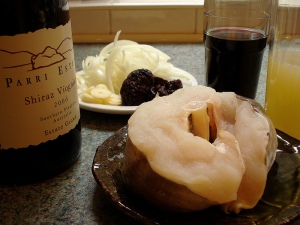
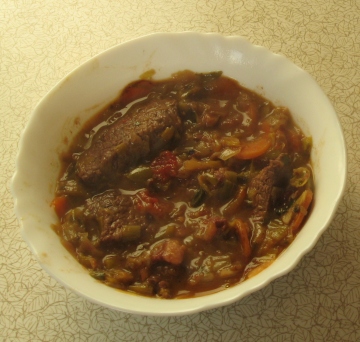
norwegianstew 016This is from Penguin’s Easy Cooking for One or Two by Louise Davies, in collaboration with the Geriatric Nutrition Unit (1972). Intended predominately as an aid for older people who  “have never had to cook and are now having to manage on [their] own”,  it’s easily the most depressing cookbook that I’ve read.  It details nutritional requirements for older people, with emphasis on things like eating the appropriate foods after operations, and simple, yet interesting dishes suitable for cooking by people who have lost interest in food due to bereavement or, slightly less depressingly, those who can no longer chew a lot of foodstuffs.   It paints a fairly bleak picture of old age – one where food preparation is at best a trial, and where all food tastes of not a lot (perhaps this is accurate, but it’s made me determined to enter old age with a commitment to cooking properly). Recipes that I shan’t be cooking include Lazy Soup (basically stock with an egg white drizzled in, a la stracciatella), Peptail (a glass of orange juice, with an egg in it) and Digestible Sardine (tinned sardines, mixed with egg. What is it with these people and eggs?). Of course there are some more complex recipes, but nothing that would excite you into actually wanting to make them.

The book is illustrated throughout with nice line drawings of culinary processes – I’ve taken a few pictures which are on Flickr.

The book also has a section on utensils, this section explains what certain items are for those who have no kitchen knowledge – the entry on oven gloves reads:

“a length of material padded on palm surface and folded over at each end to form gloves. The connecting material between the ‘gloves’ lessens the danger of burning the arms above the wrist”

I find this a particularly beautiful piece of writing; I think it’s the effort they’ve gone to to explain something that to me seems very very obvious. It’s endearing.

And now, the recipe:

Meat Stew, Norwegian Style

Serves 2 – or one serving one day, the second serving next day.

Ingredients

Half a pound of stewing steak

Half a cabbage, coarsely shredded

Half a pound of carrots, peeled and sliced

Salt and pepper

Flour

Chopped parsley (optional)

METHOD

1 Cut the stewing steak into fairly large cubes (the butcher may do this for you)

2 Using a medium size saucepan with a tightly fitting lid put in:

(a) a layer of cabbage and carrot

(b)  little seasoning and a good sprinkling of flour

(c) a few pieces of meat

(d) a little seasoning and a good sprinkling of flour

3 Continue to add layers of vegetables and meat sprinkling each layer with seasoning and flour

4 When all the meat and vegetables have been used up less than half-over with water

5 Put the lid on and simmer for about 1 hour, 30 minutes

6 Serve sprinkled with parsley if you like

Results

norwegianstew 007

Notes etc

  • I’m not sure why I thought this would a good thing to cook – it is clear from the ingredients list that this is too basic a recipe to taste even remotely interesting.
  • I have no idea what makes this Norwegian Style. Is Norwegian cuisine renowned for its mediocrity?
  • Also unclear is why they insist on layering the meat and veg before cooking. It’s a stew! Unless I wasn’t supposed to stir it at all? Is the layering considered something exciting yet easy to do so the old people don’t get bored..?
  • I over-seasoned – too much pepper. Still, at least it tasted of something.
  • I had loads left over, so tonight I sliced the beef smaller and marinated it briefly in a rudimentary Chinese 5 spice sauce, then stir-fried the veg and beef with a couple of types of mushroom and a leek, and served it with vermicelli. This was a definite improvement!
  • So, yeah. In conclusion, won’t be making this again.

→ Leave a CommentCategories: Mains
Tagged: , , , , ,

Spinach Cannelloni

5 July 2009 · 1 Comment

Here’s one I cooked about a month ago – the stodge was perfect at the time but now it’s salad weather and the idea of a creamy pasta dish is less appealing, so please cast your mind’s back to chillier times in order to give this recipe the attention it deserves.  It’s from The Sainsbury Book of CHEESE -  including Cheesecakes and Fondues by Rhona Newman, first published 1982 (this ed. 1983), so a fairly recent resource, with generally sensible recipes .  The difference between this book and Make A Meal of Cheese from 10 years previous is notable – where MAMOC was cheddar-centric here we have recipes for a range of cheeses (unsurprising really, given the publisher).  There’s still some slightly icky recipes (Sardine Fish Cream?) and some where you feel you’d have liked them to try a bit harder (I’m looking at you Garlic Sausage Spears, aka slice of garlic sausage wrapped round cream cheese on a cocktail stick).

Spinach Cannelloni

500g frozen chopped spinach, thawed

175g matured Cheddar, grated

50g fresh breadcrumbs

salt and pepper

grated nutmeg

8 sheets lasagne

25g butter

25g plain flour

300ml milk

1 teaspoon made mustard

Drain the spinach thoroughly and mix with 50g of the cheese, 40g of the breadcrumbs and salt, pepper and nutmeg to taste.

Cook the lasagne in plenty of boiling, salted water for 15 minutes or until just tender. Drain and rinse with cold water. Cut each piece in half and lay on a clean tea-towel.

Divide the spinach mixture between the lasagne and roll up. Place in a greased shallow ovenproof dish.

Melt the butter in a pan, stir in the flour and cook for 1 minute. Slowly blend in the milk, then heat, stirring until the sauce thickens . Add 75g of the cheese, the mustard, and salt and pepper to taste.

Pour over the cannelloni. Mix the remaining breadcrumbs and cheese and sprinkle over the sauce.

Bake in a moderately hot oven (190°C/ 375°F/ Gas Mark 5) for 20 to 30 minutes or until the topping is golden.

Serves 4.

Results

oxfordramble 019

Notes etc

  • This was really really delicious – it’s a very acceptable vegetarian main course that I would happily serve friends
  • I didn’t bother making up mustard; I just sprinkled powder into the mix. I couldn’t decide whether this would be more or less potent than mixing some up properly, but looking back I think I could have put more in. But then again I appear to like things flavoured very heavily, so perhaps that’s not to everyone’s taste.
  • The assembly of the lasagne and filling is messier than you’d think. Have a decent sized worktop free!
  • If you are hungry whilst making this the urge to just eat some of the spinach and cheese mix will be strong. Resist!
  • I used up more of the shop-bought breadcrumbs from the Welsh Eggs – this worked alright, but I’m pretty sure that it would be worth the effort of making your own breadcrumbs for this recipe.
  • In conclusion – really tasty, pretty darn easy, generally a winner.  Perhaps the old ones aren’t the best after all….

Nommed by Alix

→ 1 CommentCategories: Italian · Mains
Tagged: , , , , ,

Cinnamon Slices

27 June 2009 · 1 Comment

I am greatly enjoying broadening my baking repertoire through this blog and today is opportunity for another experiment. I genuinely have no idea how these will turn out – firm? Crunchy? Crumbly? (This recipe from the Good Housekeeping Institute’s Cookery Compendium,Waverly, 1955).

Cinnamon Slices

Ingredients

6oz ground almonds
8oz icing sugar
¼ teaspoon cinnamon
A little egg white
1 tsp flour

Sieve the almonds, cinnamon and 6oz sugar into a basin and mix to a fairly stiff paste with egg white. Knead with the hand until smooth, then roll out on a lightly floured board into a long narrow strip, about 1/8 inch in thickness. Make an icing by mixing the remaining sugar and flour and moistening with egg white. Spread this smoothly over the paste with a wetted palette knife, and then cut into fingers. Place on a greased and floured tin and bake in a moderate oven (350 degrees) until light brown in colour and firm and crisp to the touch – about 20 minutes.

  • I halved the recipe, as per.
  • I needed exactly half the white of a medium egg, although I added it in tiny amounts.
  • The batter tasted like marzipan, quel surprise.
  • I cut the dough into 20 small biscuits – roughly  1 x 3 cm.
  • I baked them for just over 20 minutes.
  • All very quick and simple to make.

Results

These are a cross between a meringue, an almond macaroon and those sponge fingers used in tiramisu. (I want to call them boudoir fingers?) They rose a lot when baked when surprised me – they’re at least 3 times as thick. Again, boo to the authors for not specifying how far apart the biscuits should be placed on the tray.  They rose enough to become hollow, with  thin, crisp, top layer and a pleasantly chewy, bottom layer. The amount of cinnamon is perfect, blending with the almond. The icing adds an extra texture rather than a flavour – so when I make these again, I will probably add some lemon zest to it.  This review contains the word ‘crisp’ far too many times but they are crisp and like all crisp things, they are very more-ish.

cinnamon slices

Sliced by Elly

→ 1 CommentCategories: British · Sweet things
Tagged: , , , , ,

herbed carrot salad

24 June 2009 · 2 Comments

a) apologies for the delay; b) ph34r the fusion of herbed carot salad, mashed potato, sook choo na mool and SAUSAGES! This is what happens when you cannot make salads for one, have urgent leftovers in need of eating and yet CANNOT refuse yourself sausage and mash after a tough day. Hurra?!

Ingredients

450g carrots
peeled clove garlic
1/8 – 1/4 tsp cinnamon
1/4 tsp ground cumin
1/2 tsp paprika
pinch cayenne pepper
juice of one lemon
1/8 tsp granulated sugar
olive oil to taste
salt
freshly chopped parsley to garnish

wash, peel and dice the carrots. cook in boiling water (and there I was wondering why ice water wasn’t doing the job), to which the peeled garlic has been added, for 10-12 minutes or until barely tender. drain, set aside.
combine the spices with the lemon juice, sugar and salt. Mix until blended, add to carrots, chill.
Just before serving, sprinkle with oil and chopped parsley.

results

herbed carrot salad

notes:
- 10-12 minutes!! Holy Tegoshi Batman. I expect, dear readers, you can use your own judgement as to when carrots are done and if you feel that is too long, “until barely tender” is the best guideline.
- Hate hate hate measuring things in eighths of teaspoons, also hate spice jars too tiny to fit a teaspoon in.
- How do you all juice lemons if you don’t have a juicer? My friend has a Philippe Starck one, has never used it. Anyway, I slice the lemon into rounds and squeeze each one into a cup and then make a mess scooping out the pips. I guess I got about a quarter of a US cup of juice. Juicy!

conclusion:
Hurrah but where are the herbs!! The only herbs are the parsley garnish! And guess what, I didn’t use any. I never have parsley, it didn’t say flat or curly and frankly I usually ignore garnish suggestions anyway because they – are just irritating, even if they DO look good. I don’t have a garden or any living herb plants and object to the 75% mark-up supermarkets put on those awful plastic packets arghhh SO ANNOYING. Anyway – all the lovely lemon in this was a little overpowering on first scoff, but I found myself craving the dish again in a few days time. Lemon craving?? I’d like to experiment with this some more – I’ve had good results with lemon juice, nanami (or shichimi) seasoning (japanese 7 spice basically), a bit of salt, extra pepper and some paprika. But nothing AT ALL to do with herbs!!

SERVING WITH S&M OPTIONAL

korean carrot sausage and mash ultima fusion

→ 2 CommentsCategories: Uncategorized
Tagged: , ,

Custard Creams

20 June 2009 · 5 Comments

Cream-filled biscuits seem to have dropped out of UK baking fashion in favour of American-style cookies, healthy things containing grated apple or dead easy things like flapjack (nice though all those can be).  The Good Housekeeping Institute’s Cookery Compendium (Waverly, 1955), however, is full of biscuits of every kind, from things like this (pretty much) and this to custard creams! I thought custard creams were dreamed up by some marketing person in, well, the past and I was basically right.  They were a late 19th century invention, probably by Huntley & Palmers of Reading, probably to capitalise on the new popularity of custard powder. (More info here.)

They’re still the most popular biscuit in the UK and in one of her recent publications, a certain camera-friendly Brunette cook gave a recipe for heart-shaped ones saying the it was “hitherto… only known in its packet form”. Ha! GHI got there first, missus, and armed with a 7p packet of economy custard powder, a teeny bar of Green and Blacks and some coffee essence, I shall recreate this national favourite in my own kitchen.

Custard Creams

4 oz margarine
4 oz sugar
1 egg yolk
4 oz custard powder
4 oz flour
Vanilla essence
A little milk
Butter icing

Cream the fat and sugar and beat in the egg yolk. Add the custard powder, flour and a few drops of vanilla essence and sufficient cold milk to give a dough.  Roll out thinly, prick all over and cut into squares, fingers or rounds. Bake on a greased tin in a moderate oven (375C) for about 15 minutes until very lightly coloured. Cool on a wire tray.

When the biscuits are quite cold, sandwich them together in pairs with butter icing, either plain or flavoured with coffee essence or chocolate. Serve with sieved icing sugar dredged over the top.

Chocolate Butter Icing

2 oz butter or margarine
3 oz icing sugar
A little vanilla essence
1 oz block [sic] chocolate

Cream the fat, then add the sieved sugar a little at a time, and blend together. Add a few drops of vanilla essence, and lastly mix in the melted chocolate.

Coffee Butter Icing

Use the above recipe [Vanilla buttercream: 3 oz butter or margarine, 4oz icing sugar, vanilla essence, colouring, if required], beating in coffee essence to taste.

Notes

  • I halved the recipe.
  • I used margarine in the biscuits and butter in the icing.
  • As with the golf biscuits (and again, probably because of the margarine), it didn’t need any milk. I mixed it into perfect dough, felt like I might be cheating as I hadn’t added any milk, added a teaspoon and regretted it when it instantly became too sticky and needed lots of flour when rolling out. Maybe this is a difference between margarine at the time of writing and today? Margaret Thatcher worked out how to get more air into icecream when she was a scientist. Perhaps there is more water in marg these days? Anyway, in the future if I am instructed to ‘add sufficient milk to give a dough’ and sufficient milk is no milk at all, I shall add none.
  • Again this recipe doesn’t say how widely spaced the biscuits should be on the tray, nor how many this dough should produce – not good for learners, GHI!

Custard creams un-iced

Results

The uncooked dough smelt and tasted exactly like shop-bought custard cream biscuit. (What!? Uncooked dough sampling is an important part of trying a new recipe.) The batch I made produced 18 biscuits, 2 – 3 inches across. I don’t own a plain round cutter and the crimped edges spread messily. (As the dough was quite soft, I didn’t want to risk using an empty jar to cut them out.) I made 2 small batches of buttercream icing – one chocolate, one coffee. I didn’t ice all the biscuits, but kept some plain stored in an airtight tin and the icing in the fridge, so they could be iced as necessary to avoid going soggy. Both stayed fresh for a week.

After baking however they were quite different to the commercial version. The vanilla flavour is quite pronounced (of course) and the texture was unlike any biscuit I’ve made before – both light and slightly chewy.  (I imagine the lightness is caused by lower gluten content.) This wasn’t what I expected – I expected something like shortcake. They went from chewy to positively bendy 6 hours after baking. (Really, I could bend them,  I can’t believe I didn’t take a photo of this.) By the following day, they had crisped up completely and the icing was a good contrast to this.

They were as rich and sweet as you would imagine, I think with vanilla buttercream they would have been inedible – I liked the coffee and chocolate iced versions equally. If I made them again, I would add some spice to the dough and some booze to the icing. This biscuit reminded me most of all why I bake at home – there is simply nothing like this that one could buy.

custard cream - Copy

→ 5 CommentsCategories: British · Sweet things
Tagged: , , , ,

Crispy Corned Tuna

14 June 2009 · 4 Comments

My second from the St Michael All Colour Budget Cookery Book. The fish pie was not so dreadful that I was scared to try another from this tome, so I went for another fishy dish. This recipe is truly budget, and with the addition of the crisps on top is definitely not one to serve to grown-ups. Actually, thinking about it I’m not sure it’s suitable for children either (I think cats might like it though).

Crispy Corned Tuna

Almost all the ingredients for this crispy-topped pie come from the store cupboard, and it takes less than half an hour to prepare and cook.

25g butter
25g flour
300ml milk
50g cheddar cheese
Salt and freshly ground black pepper
1 x 200g can of tuna fish
1 x 326g can sweetcorn
2 large tomatoes, finely sliced
1 x 71g packet salted potato crisps

Melt the butter in a saucepan. Stir in the flour and cook for 1 minute. Gradually add the milk and bring to the boil, stirring constantly. Simmer for 2 minutes, stir in the cheese and season to taste. Flake the tuna and add to the sauce with the liquid from the can. Fold in the drained sweetcorn. Use the tomato slices to line a greased ovenproof dish. Spoon the tuna mixture into the centre of the dish and crumble the potato crisps on top. Place in a moderate oven (180°C/ 350°F/ Gas Mark 4) for about 20 minutes, until the top is brown and crisp. Serve with slices of thick French bread.

Results

miscfood 092

Notes

  • This was actually more hassle to make than it was worth
  • 71g bags of crisps are hard to come by! I used three 24g bags.
  • The end result was a lot more liquid than I expected – I imagined something more like a pasta bake, but it was more akin to a thick soup
  • Too much sweetcorn. Far too much.
  • The crisps form a chewy sheet that floats atop the goo, gradually becoming limper and limper. Delicious, I think not.
  • Overall kind of grim, I had some for lunch with basmati rice, and that improved it a little.

→ 4 CommentsCategories: English · Mains
Tagged: , , ,

sook choo na mool (korean bean sprout salad)

13 June 2009 · 3 Comments

Salad number two from week of salad: Rosalie Swedlin, World of Salads. Serves 6. Six!! Good job I can eat a lot of beansprouts. Never scale down, never surrender! Or er something or other…

ingredients

225-275g (mung) bean sprouts
4 spring onions, chopped
1 small red pepper, cored, deseeded, finely chopped up
1 minced clove garlic
4tbs veg oil
2tbs white wine vinegar
2tbs soy sauce
salt and pepper
2 tbs toasted sesame seeds

to make dressing: mix the oil, vinegar, soy sauce, garlic and freshly ground pepper. Soy sauce is quite salty so spare the salt. Place bean sprouts, red pepper and spring onions in a large wooden salad bowl. Pour dressing over the salad and toss gently. Chill for at least an hour. Just before serving, add toasted sesame seeds and toss again.

results

sook choo na mool

notes:
- So did anyone sprout their “mung” the other day when I gave you the heads up?
- More commonly spelt ’sukju namul’ (숙주나물), but at least you know the “u”s are long! – I looked up some comparison recipes and it doesn’t appear this usually includes the red pepper, but heck, it adds some nice colour and I like raw peppers (as long as they’re not green – indigestible). The internets tells me also that the bean sprouts are generally blanched first til they turn translucent as opposed to the zero cooking we get here. here’s a companion recipe fyi. incidentally, it says you have to eat immediately as the sprouts don’t last – done this way, they were fine when I ate some next day.
- I didn’t add any extra salt, and neither did I toss in a large wooden salad bowl, because I don’t have one. Do any unmarried people have large wooden salad bowls? They are only ever given as wedding gifts! I used a red plastic bowl from IKEA and if that makes a huge difference – whatevarrrrrr.

conclusion

Dude, despite all the oil and vinegar and soy sauce, it still tasted like cold bean sprouts, and if it weren’t for the delicious sesame seeds this would be a bit of a chore by itself. But this is a side dish and should accompany a bunch of stuff – I had mine with chicken and udon noodles (i realised why udon noodles are so grate – they’re basically *long gnocchi*). This book is kind of annoying me because you have no idea whether things are stand alone meals or side dishes, or if they’re side dishes what they’re good served along with. Growl. I’d make it again but i don’t think there’s much need for all that vinegar. And why not add a tbs or two of sesame oil instead of the veg? And I think blanching would make it feel a bit less like… grim faced cold bean sprouts. Serve with hot carbohydrates! Mmm, hot carbohydrates…

The next and final salad of the week is herbed carrot salad! Can you stand the excitement. Watch out for its incorporation in the new style of fusion I call “idiotface”!

→ 3 CommentsCategories: Korean · Sides
Tagged: , , , , , ,

Rosy Baked Chicken

12 June 2009 · 6 Comments

This is from Family Circle Home Entertaining published by Albany Books in 1980.  With chapters such as ‘Wine Sense’, Giving a Cheese and Wine Party’ and ‘A Wedding Buffet Planned at Home’ it offers everything necessary  for one to entertain on a large scale and if this sample recipe is anything to go by it also offers everything necessary to make sure that your guests will think twice before accepting an invitation to future soirees.

Rosy Baked Chicken

4 chicken joints
1 small (200g) can sliced pineapple

Sauce
50g margarine
1×15ml spoon plain flour
2×15ml spoons tomato ketchup
2×5ml spoons dry mustard
1×2.5ml spoon salt
Pepper
1×5ml spoon Worcestershire sauce
1×15ml spoon vinegar

1 (200g) pack frozen peas
1×10ml spoon cornflour

1. Remove skins from chicken  joints. Wipe joints with kitchen paper and place in a large roasting tin.
2. Drain pineapple, reserving syrup in a small basin. Chop pineapple.
3. Place margarine in a basin and beat until soft and creamy. Beat in remaining sauce ingredients and half of chopped pineapple.
4. Spread mixture evenly over chicken joints. Pour pineapple syrup over and sprinkle with remaining chopped pineapple; cover with foil, If possible , leave in fridge until ready to set in oven.
5. Remove the foil and place on shelf just above centre of oven. Set oven control to moderate (190°C/ 375°F/ Gas Mark 5) and bake for one hour. Ten minutes before end of cooking time , cook peas, as directed on pack. Place chicken joints on warmed serving dish and keep hot whilst making gravy. Blend cornflour with a little water and stir into juices left in roasting tin. Cook gently for 3 minutes; pour over chicken joints. Arrange cooked, drained peas on a dish around chicken or serve separately.

How this looked before cooking:

miscfood 024

After cooking:

miscfood 032


Notes

  • I used butter instead of marg
  • I made half the amount, and used thighs and drumsticks as I couldn’t get joints
  • I didn’t have the peas, and omitted the gravy as I couldn’t find cornflour
  • Pre-cooking the resemblance to puke was uncanny.
  • The juices left in the dish afterwards were really offputting, and the leftovers that I removed from the fridge the next day were encased in an orange  lump of solidified fat. Mmmmm.

Conclusion

Despite smelling like a nice barbeque whilst in the oven, it tasted a little weird, and the coating didn’t really adhere to the meat well at all. I think it would have been much nicer had the skin remained on. The combination of butter and ketchup and pineapple is not quite to my taste, it’s a little sweet. Overall this wasn’t particularly nice, the coating didn’t compliment the chicken, and my general feeling was that I was eating some nice chicken which was being spoiled by an odd sauce. I suspect that if cooked at a higher heat, with the skin on it may have a) looked more like the photo, and b) tasted alright.

→ 6 CommentsCategories: Mains
Tagged: , ,

Golf Biscuits

11 June 2009 · Leave a Comment

An excellent find last week – a 1955 (3rd) edition of the Good Housekeeping Institute’s Cookery Compendium, first published by Waverly in 1952, for £3.50 in a local charity shop (prices for it on Amazon start at £21).

The book is divided into 3 sections – Basic cookery , Picture Cookery (a bit more advanced and with extra skills like jam-making) and Picture Cake Making (which if read for too long will induce nausea , even if you are an icing-loving fiend like me).

From the introduction :

“Here, in one handsome volume, is a true Home Cooking Companion. [Random capitalisation always reminds me of religious pamphlets.]  It is produced with an eye to the needs of every member of the family and presented in attractive pictorial form, so that young daughters can be shown all the basic processes of cookery, and mothers can embark on ambitious recipes in the certain knowledge of success.”

The reader is also promised “nearly 2000 photographs, of which 64 are in wonderful, natural colours” (i.e. not in the slightest bit natural).

The politics of the book only improves after this point and I may go into that further in a future post, for today I just need a simple biscuit recipe.

Golf Biscuits

2 oz margarine or dripping
8oz fine oatmeal
2oz brown sugar
A pinch of salt
½ tsp cinnamon
1 tsp cream of tartar
½ tsp bicarbonate of soda
1 egg
A little milk

Rub the fat lightly into the oatmeal. Mix in the other dry ingredients. Form into a paste with the beaten egg and a little milk. Knead until smooth, and roll out to ¼ inch. Cut into rounds, prick and bake on a greased tin in a moderate oven (350 – 75 C degrees)for 15 – 20 minutes, until crisp

Notes

  • Margarine is much stickier than butter and this was a mess to rub in and even more so to roll out, cut out and move onto the baking tray. My fingers were quickly covered in grease and grains of oatmeal and sugar and had to be washed twice.
  • I tried rolling the dough out with the rolling pin clean and then sprinkled with flour. With flour was worse, as this seemed to dry the dough out and make it break into pieces further.
  • The last two biscuits were formed out of balls of dough, squeezed flat.
  • I halved the recipe as per  – why doesn’t it say how many will be produced by the recipe?
  • I used about a teaspoon of milk. Maybe this was too much? I added the milk along with the beaten egg, without mixing the egg in first. Probably the milk was unnecessary, but it was in the recipe!
  • I forgot to prick them but the dough was so sticky, I don’t think they would have held.

Golf biscuits

Conclusion

This recipe produced 7(!) biscuits, very light and crisp with boring flavour – at first vaguely reminiscent of honey, but leaving a faintly metallic after-taste. 10 minutes after eating the first one, I am still nibbling on grains of oatmeal which stuck in my teeth.

I should have guessed that this recipe wouldn’t work, a quick google yields a biscuit with the same name but containing treacle and a little flour, both of which would help the texture and flavour. I was attracted to the simplicity of the recipe but somehow the tastes of the ingredients just don’t blend together.

I’m incredibly prejudiced against golf and all things golf-related and will continue to be so – even their snacks are rubbish.

Baked by Elly

→ Leave a CommentCategories: British · Sweet things
Tagged: , , , , , ,